 Ravnote
How to write a game design document (GDD) that doesn't go stale
The game design document (GDD) is where the idea of your game lives: what it is, how it plays and why it's fun. Here are its sections, a template to copy, and how to keep it useful when the game changes, because it will.
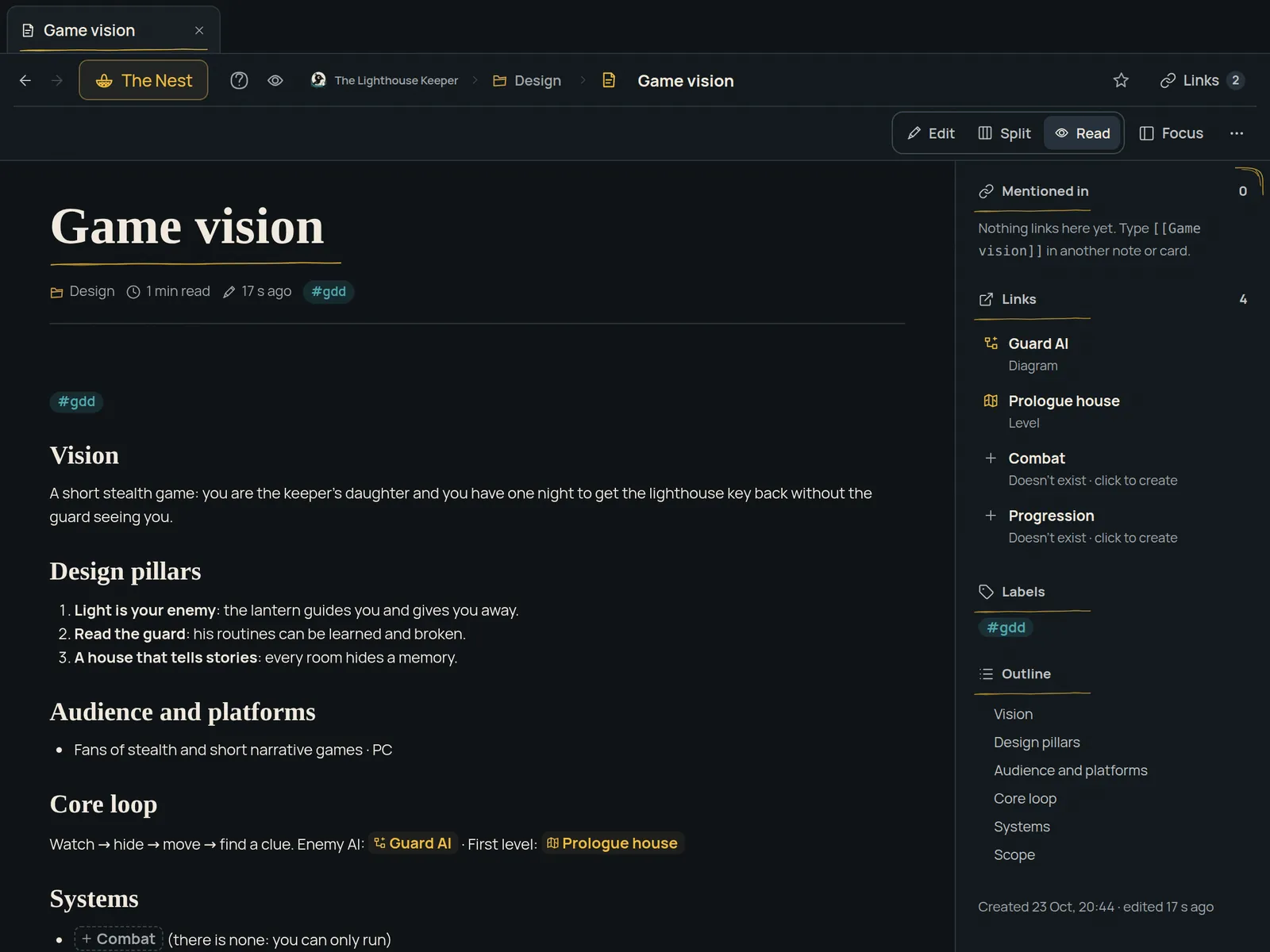
Why so many GDDs end up in a drawer
The problem is almost never writing it, it's keeping it current. The classic GDD is a huge document written at the start, out of date within two weeks and never opened again. Stats end up in a spreadsheet, dialogue in another tool and tasks on a board. Nothing talks to anything, and the document stops telling the truth.
Teams that actually use theirs do three things: they keep it short, they split it into small pieces (one per system, character or level) and they link it to the rest of the project so that when one piece changes, you can see what else is affected.
The sections of a good GDD
- One-page vision. What the game is in one sentence, who it's for, how it should feel and what makes it different. If you only write one page, make it this one.
- Design pillars. Three or four rules that settle debates. For example: "the player never fights head-on", "every room tells a story".
- Game loop. What the player does every minute, every session and across the whole game. A diagram helps far more than a paragraph.
- Mechanics and systems. One page per system: how it works, which numbers it uses and how it relates to the others.
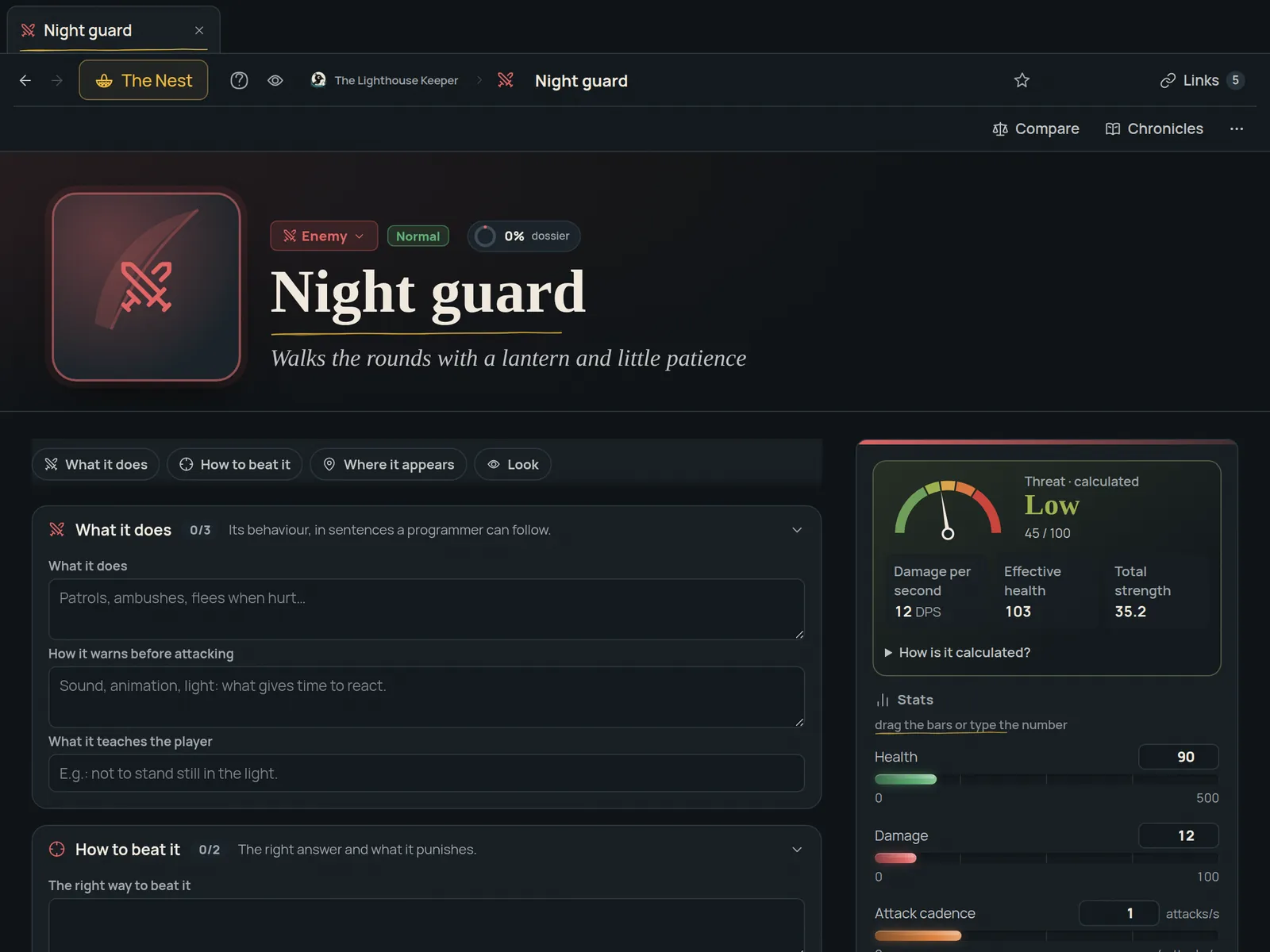
- Characters, enemies and items. Better as entries with data than as loose text, so they can be compared and balanced.
- Levels. Goal, pacing, enemies, secrets and a map, even a rough one.
- Narrative and dialogue. The overall arc and the conversations, with their branches and the variables they change.
- Economy and balance. XP curves, prices, damage and health. With formulas, not hand-typed numbers.
- Art and sound. Visual references and the tone you're after (a moodboard is worth a thousand words).
- Production plan. Milestones, scope and what's out. Saying no is design too.
GDD template to copy
1. Vision
The game in one sentence · Genre and platform · Audience · How it should feel · Reference games · What makes it different.
2. Pillars
Three or four rules that never break.
3. Game loop
Minute to minute · Session to session · Long-term progression.
4. Systems
For each system: what it does, how it's controlled, which numbers it uses, how it connects to others and how you know it works.
5. Content
Entries for characters, enemies, items and places · Levels with goal, pacing and map · Dialogue.
6. Balance
XP, economy and combat formulas · Charts · Test values.
7. Production
Milestones · Minimum scope (must-haves) · What's out.
How to keep it alive
- One document per idea, not one document for everything. A short page is easier to update than searching inside a hundred.
- Link instead of copying. If the guard appears in a level and in a dialogue, link his entry; don't copy his data.
- Review at every milestone. Ten minutes deleting what's no longer true saves hours of confusion.
- Write for whoever joins late. Someone new should understand the game by reading the vision and the pillars.
How it works in Ravnote
Ravnote is built for exactly this. You write the vision and the systems in linked notes; typing two brackets suggests your entries, levels and dialogue, and the link never breaks even if you rename things. Enemies and characters are entries with stats you can compare in a table; levels are drawn in 2D or in a 3D room using those same entries; dialogue is written with branches and play-tested; and balance uses formulas and charts. Everything works offline and is saved on your computer. When you want to share it, export it to Markdown, PDF or a website.
Frequently asked questions
How long should a GDD be?
Just long enough for the team to make decisions without asking you. For an indie game, a one-page vision plus a short page for each important system, character or level is usually enough. A short, up-to-date document beats a long one nobody reads.
GDD in a doc, a wiki or a game design tool?
A text document is fine to start with, but it goes stale as soon as the game changes. A wiki links better, but it knows nothing about your stats or your dialogue. A tool built for game design, like Ravnote, links the text to your entries, levels and balance, so you change something once and everything knows.
Do I need a GDD if I work alone?
Yes, just a shorter one. It helps you remember decisions, pick the project back up after weeks away, and explain the game to a publisher, a teammate or yourself a year from now.

Your whole game, in one nest.
Ravnote brings ideas, entries, levels, dialogue, balance and tasks together in a desktop app that works offline. Founder price: €49 a year.
See Ravnote and its pricing Watch the video (1:58)